

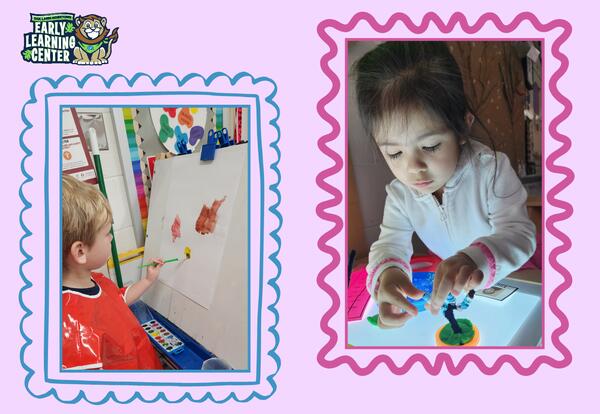
Before children ever put pencil to paper, their bodies need to be ready, especially their hands. Fine motor skills are the small but powerful movements of the fingers, hands, and wrists that allow students to grasp, control, and manipulate tools like crayons and pencils. Activities such as counting and stringing beads help strengthen the tiny muscles in the hands while also building hand-eye coordination and endurance.
.png?mask=1)
These skills don’t develop overnight. Children first learn to use their whole arm and hand, then gradually gain the control needed to pinch, twist, squeeze, and hold objects with purpose. Experiences like painting with brushes, fingers or other objects, spreading and swirling shaving cream to form letters, squishing and cutting playdoh, snapping beads, and other sensory-rich activities give students repeated practice using their hands in meaningful ways. These playful tasks also encourage creativity while reinforcing early letter awareness, without the pressure of “perfect” handwriting.
.png?mask=1)
When students have strong fine motor skills, writing becomes less frustrating and more successful later on. With the strength and control to hold a pencil comfortably, children can then focus on forming letters and sharing ideas. Through hands-on and engaging activities, whether beading icicles on trees, painting, writing in shaving cream, or simply letting sand fall through their fingers, students are building the foundation to become confident, capable writers.
.png?mask=1)
.png?mask=1)