

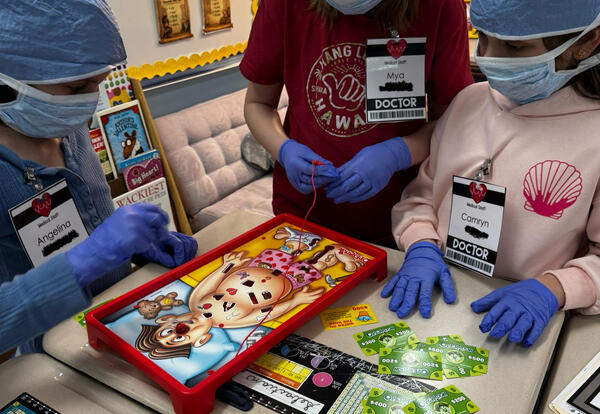
Third grade doctors perform "surgery" during the CKLA celebration.
Third grade students wrapped up their CKLA Human Body unit with an unforgettable culminating experience. After weeks of reading, discussing, investigating, and learning about the body’s systems, students had the opportunity to rotate through engaging, hands-on stations that brought their knowledge to life. The classroom was transformed into an interactive learning lab where science met creativity, teamwork, and fun.
The culminating celebration was thoughtfully designed to review and reinforce the major systems students studied throughout the unit: skeletal, muscular, circulatory, nervous, digestive, and respiratory. Each station gave students a chance to demonstrate their understanding in a meaningful and memorable way.
Students used cotton swabs to construct miniature skeleton models on black construction paper. Before beginning, they reviewed the major bones they had learned about, including the skull, ribs, spine, pelvis, femur, and tibia. Students discussed how the skeleton provides structure, protects vital organs, and allows movement when working together with muscles.
At the circulatory system station, students worked on a detailed coloring page that illustrated the heart, arteries, veins, and capillaries.
This visual and hands-on reinforcement helped students connect vocabulary words to real biological processes.
Laughter and concentration filled the room at the nervous system station, where students played the classic game Operation. Students put on their official "doctor gear" and reflected on how the nervous system sends messages between the brain and the rest of the body. When the buzzer sounded during the game, it provided the perfect example of how nerves quickly respond to touch and send signals to the brain.
Learning became even more memorable at the digestive system station, where students enjoyed bone-shaped graham crackers as a themed snack. Before eating, students reviewed the digestive process—from the mouth to the esophagus, stomach, small intestine, and large intestine.
The muscular system station challenged students to complete a body puzzle featuring major muscle groups. Working in small teams, students assembled pieces representing muscles such as the biceps, triceps, quadriceps, and abdominal muscles.
At the respiratory station, students reviewed how the lungs and diaphragm work together to bring oxygen into the body and remove carbon dioxide. Students practiced taking deep breaths while placing a hand on their chest to feel their lungs expand.
The culminating experience was a celebration of growth and understanding. Throughout the CKLA Human Body unit, students built vocabulary, strengthened reading comprehension, and developed a deeper appreciation for the complexity of the human body.
By rotating through interactive stations, students engaged in multiple learning styles—visual, kinesthetic, auditory, and collaborative. The activities allowed them to apply knowledge in creative ways, reinforcing key concepts while having fun.
The Human Body culminating celebration was a powerful reminder that learning is most meaningful when students are actively involved. Through creativity, collaboration, and curiosity, third graders not only completed their CKLA unit—they truly brought science to life.